Tuesday, 27 December 2011

Grid: Augmented Reality Gaming


Grid is an Augmented Reality environment which provides a spatial configuration for real-time gaming at an architectural scale. This project showcases a prototype of the AR environment devised at one to one scale to test the possibilities of augmented reality in the built environment. The project uses a simple architectural maze which people can navigate through in real-time.  The prototype was developed for the iphone using Qualcomm Augmented Reality SDK and Xcode.


This project aims to explore new ways of inhabiting and interacting in social spaces. To enhance social activities in architectural spaces we can augment the space with interactions which merge reality with digital practices which occur on social networking platforms. More people partaking in the augmented space results in a much more dynamic environment and heightened social engagement. To propose a new way of experiencing and circulating through the city, an architectural playground that allows for increased social engagement with the building and the objects within.  These include gaming hot spots which utilize mixed reality to transform the city with interactive playgrounds

The use of augmented reality technology in architecture was evaluated in light of creating new meaningful spaces of interaction and discourse which can be non-regulated, open source and allow for freedom of expression.  The future of AR provides us with several possibilities on how virtual architecture can impact on urban space. This technology presents a new methodology for implementing some of the key ideas on temporality, and adaptation, social participation and improvisation in the quest for achieving democratic alternatives to occupation and inhabitation in public space.  The synthesis of AR and physical space has a profound impact on shaping human interaction in the same manner as the internet and mobile phones have in recent times. Moreover the overlay of data onto our visual experience fosters new levels of engagement which can radically transcend the limitations of stationary screen based information.  The quest for hybrid spaces of the future should mediate the superimposition of digital and physical in a way which can enrich the experience and inhabitation of the occupants in a site specific manner. This technological liberation should provide citizens with new forms of expression and an extension to the physical, social and cultural characteristics of a location..

Thursday, 17 November 2011

Digital Ouija


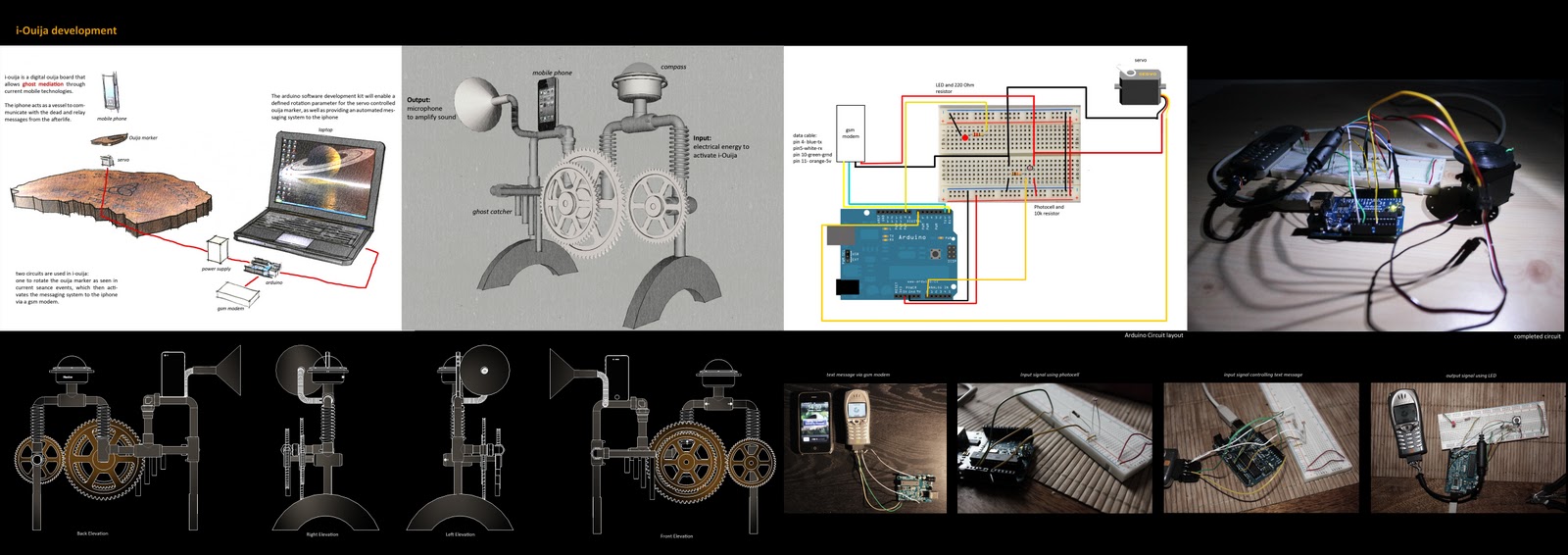
The i-Ouija is centred on the notion of how we can enhance reality with the use of an additional method of communication with unseen dimensions. This prototype is an example of how we can integrate existing technologies such as smart phones with ancient forms of inter-dimensional communications such as a seance. The iphone in this project acts as a portal to new dimensions that we can’t necessarily see.  This project was inspired by the the late Steve Jobs who revolutionised the mobile phone with smart technologies such as the iPhone. The question wheel is also governed by subjects which steve jobs mentioned in his Stanford commencement speech in 2005, and the message system relays some quotes from that speech.  
This project is clearly hypothetical and although the device captures some of the key tools in traditional ghost hunting events, such as compass and wind chimes, the question and answer system is purely governed on an automated circuit which responds to an input signal from the neighbouring installation. 
Overall the key aims of the project are to merge the ideas of virtual reality with the physical environment. The physical device helps to enhance the use of digital media and materialise the power of digital technology. Technologies that cater to augmented reality will act as portals that link you to information, communities and destinations in real-time.


Thursday, 20 October 2011

Haunt

I came across this project recently by usman Haque and I think its pretty interesting and somewhat relevant with my current work!

http://www.haque.co.uk/haunt.php

"Using humidity, temperatures and electromagnetic and sonic frequencies that parapsychologists have associated with haunted spaces, this project aims at building an environment that feels "haunted": a non-visual architecture."

Tuesday, 11 October 2011

Ghost Mediation!

I think the title says it all! a digital ouija board that communicates with ghosts through mobile technology!


Saturday, 8 October 2011

New year in unit 14!


If we assume that superstring theory is correct, the idea of a world consisting of 10 or more dimensions is one we will have to come to terms with and try and understand. However how is it really possible to provide a visual representation of a higher dimension that will truly satisfy the human mind? Although this is a topic which has fascinated artists throughout history, this exercise was conducted to try and break down some simple principles concerned with how we 3-dimensional beings would perceive the built environment from the 4th dimension.

In the book Flatland:A Romance of Many Dimensions by Edwin Abbott, a Square (the main character in Flatland, 2d dimensional world) travelled to Lineland(1 dimensional world), where he could see their entire world at once. The King of Lineland at first doesn’t know who is talking to him, because he can’t see the Square at all. Later in the story Square moves into Spaceland (3dimensional world), and is able to look down upon his own 2d world.
Taking this book as the main point of inspiration, we can see that If we moved into the 4th spatial dimension, we would be able to see our world at all once. We would see the interior and exterior of the built environment simultaneously.